POLITICS
The “Center of Aryan Civilization” in Dushanbe: Tajik History or Rahmon’s Version?
President of the Republic of Tajikistan Emomali Rahmon made the front pages of state media with his new proposal regarding the creation of Tajik national consciousness. According to state media, Rahmon proposed the creation of a “Center of Aryan Civilization” and an “International Nowruz Center” in the capital of Tajikistan during a conference of the […]
President of the Republic of Tajikistan Emomali Rahmon made the front pages of state media with his new proposal regarding the creation of Tajik national consciousness.
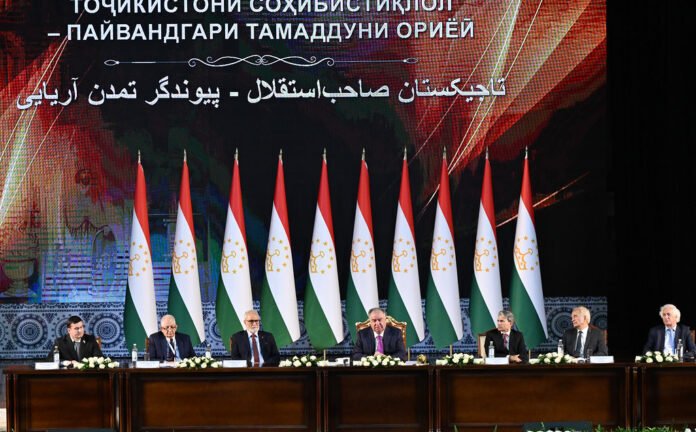
According to state media, Rahmon proposed the creation of a “Center of Aryan Civilization” and an “International Nowruz Center” in the capital of Tajikistan during a conference of the forum of Tajiks and Persian-speaking peoples of the world, held on September 7 in Dushanbe. He also called for the widespread dissemination of Ferdowsi’s “Shahnameh” and the strengthening of the role of the Tajik language in science, technology, and diplomacy.
The scientific forum of the World Association of Tajiks and Persian-speaking Peoples “Payvand” on the theme “Independent Tajikistan – the Connecting Link of Aryan Civilization” took place on September 7 in Dushanbe. According to official data, more than 230 people from 27 countries participated in the conference, including scholars, researchers, writers, and representatives of Tajiks and Persian-speaking peoples living abroad.
During his speech, Rahmon, who heads the “Payvand” Association, stated that this organization has become a platform for the integration of Tajiks and Persian-speaking peoples of the world during the years of independence. He declared that preserving the national identity and cultural unity of Persian-speaking peoples in the context of competition among languages and cultures is of “enormous significance.”
One of the president’s proposals was the creation of a “Center of Aryan Civilization” in Dushanbe. According to the president, this organization should become a scientific and cultural center.
Rahmon also proposed the creation of an “International Nowruz Center.” According to him, such a center could strengthen Tajikistan’s role in popularizing and promoting the values of Nowruz at the international level. The president also emphasized the importance of the widespread dissemination of Abulqasim Ferdowsi’s “Shahnameh,” and called the revival of the festivals of Nowruz, Sadeh, Mehrgan, and Tirgan among the important initiatives of the independence period.
Creating Identity or Personality?
Independent experts on this issue believe that Emomali Rahmon has played an important role during the years of independence in advancing proposals and projects related to the formation of Tajik identity, and no one doubts this. However, the fundamental question is that the history of the state is gradually being transformed into the history of one person.
Tajikistan’s independence was declared on September 9, 1991. At that time, Emomali Rahmon was not yet the head of state. He became Chairman of the Supreme Council in 1992. However, the efforts visible today in state media indicate that the people should gradually accept that all of today’s national achievements and all of Tajikistan’s history have been attained solely through the “efforts” of one person—Emomali Rahmon. Just as he previously effectively excluded other political parties of the country from the inter-Tajik peace agreement and attributed all credit to himself.
In the space of state media today, a version is being created as if the creation of the state, peace, independence, the revival of culture, and even national achievements of later years are primarily associated with the name of Emomali Rahmon. For example, official publications always emphasize his contribution as central to the restoration of state structures, peace, and unity.
However, independent experts question why a national achievement should be presented as the personal accomplishment of a country’s leader who came to power through disputed elections—elections criticized and questioned by independent observers due to lack of transparency and competition—and has held power in his hands for more than thirty years.
The people must know
The expert emphasizes that alongside the creation of such an atmosphere in state media, the people must know:
- independence is not the property of one president. It is a concept of statehood and a historical achievement of the entire society. History should not be written for the sake of one person.
- The World Bank and other international financial organizations have repeatedly reported that remittances from migrant workers sent to the country from abroad constitute the main part of Tajikistan’s economy. The dedication of this disadvantaged segment of the population must be recorded in history. They are the primary source of Tajikistan’s food security and Tajik households.
Even in the case of the peace of the 1990s, history should also not be limited to one person. Official sources acknowledge that achieving peace required lengthy negotiations, patience, endurance, and political concessions from all sides.
Therefore, the main question is not what role Emomali Rahmon played in Tajikistan’s post-war history. The question is why the current government (represented by one political party) is striving by all means to record the country’s political history and all national achievements in the name of one person, presenting historical facts as his personal merits.
This is also connected to the example of the “Center of Aryan Civilization”: when a multi-thousand-year historical and cultural heritage is linked to contemporary politics and the role of one leader, the people are instilled with the notion that the identity of an entire nation and the revival of civilization are occurring through the “efforts” of one person.
Independence is an achievement of the people, society created the state, history is written not by one person but by generations. The question arises: why should all of this today be consolidated and recorded in the name of one president? What will historians, political scientists, scholars, and representatives of the contemporary Tajik intelligentsia answer to future generations for this distortion of history?