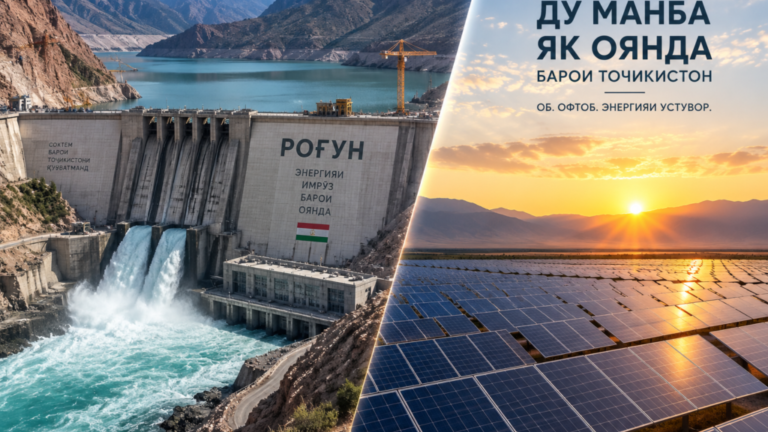
Rogun HPP or Solar Panels, Which Are Rapidly Becoming Cheaper?
According to the latest estimates, completing the construction of Rogun HPP will require approximately $6.3 billion more. Including amounts already spent, the real cost of this project, which has been under construction for over half a century, may exceed $10.5 billion. While the costs of building wind and solar power plants are rapidly falling and […]
AZDA TV· 07.09.2026
According to the latest estimates, completing the construction of Rogun HPP will require approximately $6.3 billion more. Including amounts already spent, the real cost of this project, which has been under construction for over half a century, may exceed $10.5 billion.
While the costs of building wind and solar power plants are rapidly falling and projects are completed much faster, wouldn’t it make more sense to build solar power plants in sunny Tajikistan instead of Rogun HPP?
Estimates indicate that solar power plants that could be built for $6.3 billion would generate more electricity than Rogun HPP at $10.5 billion.
The World Bank notes that completing the construction of Rogun HPP from its current stage will require an additional $6.29 billion. This is not the full historical cost of Rogun HPP—this is the amount needed to complete construction starting today. According to Tajikistan’s authorities, approximately $4 billion has been spent on the construction of Rogun HPP to date. The projected generation capacity of this hydroelectric power plant after full commissioning will reach 14.4 billion kWh per year.
Реклама / Advertisement
According to the International Renewable Energy Agency (IRENA), in 2024 the average cost of building a large-scale solar power plant worldwide was approximately $691 per kilowatt of capacity. However, as solar panel prices are rapidly declining, in 2025 the price per kilowatt fell to $599. If prices continue to decline at the same rate, in 2026 the cost of producing one kilowatt of generation capacity could drop to $520.
However, to ensure our calculations are not approximate, let us use the confirmed price for 2025. If we conditionally accept the World Bank’s estimate that $6.29 billion will be needed to complete Rogun HPP, we can calculate how much solar energy could be obtained by spending this amount on solar panels. The result would be: $6.29 billion ÷ $599/kW ≈ 10.5 GW of solar capacity.
Now let us calculate solar electricity generation. To keep the comparison consistent with the previous calculation, we will first use IRENA’s global average capacity factor for solar power plants—approximately 17.4%: 10.5 GW × 8,760 × 17.4% ≈ 16.0 billion kWh per year. Here, 8,760 is the number of hours in a year (365 × 24 = 8,760).
Even using the global average capacity factor (although this indicator is significantly higher in Tajikistan), the installed capacity of a solar power plant would be approximately 10.5 GW versus approximately 3.78 GW for Rogun HPP. Annual generation would be approximately 16 billion kWh and 14.4 billion kWh, respectively. That is, at 2025 prices and even accounting for a global average capacity factor of 17.4%, the same $6.29 billion invested in solar energy could provide approximately 1.6 billion kWh more electricity per year.
However, Tajikistan has indicators above the global average due to a greater number of sunny days. If we use a capacity factor of 20–22%, the same 10.5 GW would yield the following results:
20% → approximately 18.4 billion kWh per year 22% → approximately 20.2 billion kWh per year
Thus, the difference becomes even more substantial:
Rogun HPP → 14.4 TWh per year Solar power plant, CF 20% → 18.4 TWh per year Solar power plant, CF 22% → 20.2 TWh per year
In terms of “how many kWh of electricity per year one dollar will produce,” a solar power plant with the same investment volume can provide approximately 28–41% more electricity than the final output of Rogun HPP.
However, a solar power plant cannot generate electricity at night. Therefore, to supply consumers with electricity after sunset, an energy storage system is required—batteries that allow electricity generated during the day to be stored and used during nighttime hours. Consequently, the cost of batteries must be added to the cost of the solar power plant.
So, Rogun HPP will generate approximately 14.4 TWh of electricity per year. On average, this corresponds to approximately 14.4 TWh ÷ 8,760 ≈ 1.64 GW of constant average power. If it is necessary to provide such power after sunset for 4 hours, approximately 1.64 × 4 ≈ 6.6 GWh of usable energy will be required.
IRENA in 2025 estimates the global average cost of BESS (Battery Energy Storage System) at approximately $171/kWh. If we assume a round-trip efficiency of approximately 90%, then to obtain 6.6 GWh of actually available electricity, approximately 7.3 GWh of installed battery capacity will be required.
Thus, the cost of batteries alone will be approximately: 7.3 million kWh × $171 ≈ $1.25 billion. In addition, approximately 10% energy losses during battery charging and discharging must be accounted for.
Using this method, more precise calculations would look like this:
System
CF 20%
CF 22%
Solar power plant 14.4 TWh
$4.92 billion
$4.48 billion
Solar power plant + 4-hour battery
~$6.26 billion
~$5.81 billion
Solar power plant + 8-hour battery
~$7.60 billion
~$7.14 billion
Solar power plant + 12-hour battery
~$8.94 billion
~$8.47 billion
Rogun HPP
$6.29 billion
$6.29 billion
In simpler terms, when adding a 4-hour battery, under the CF = 20% scenario, the total cost of the solar power plant and batteries will be approximately $6.26 billion—practically the same as the $6.29 billion allocated for Rogun HPP.
If CF = 22%: the cost will be approximately $5.81 billion, meaning that even with a 4-hour battery, the amount will be $480 million below $6.29 billion. However, if batteries are calculated for 8 or 12 hours, a solar power plant with batteries will cost more than Rogun HPP.
On the other hand, the cost of new electricity is also changing. According to IRENA’s new 2025 report:
Solar power plant → $44/MWh = 4.4 cents/kWh
Hydroelectric power plant → $62/MWh = 6.2 cents/kWh
Overall, if comparing only annual electricity generation volume, with an investment of $6.29 billion, a solar power plant could produce approximately 16–20 billion kWh per year, while Rogun HPP’s average annual generation is projected at 14.4 billion kWh.
To produce the same 14.4 TWh per year, a solar power plant would require approximately $4.5–4.9 billion. If batteries with 4 hours of energy storage are additionally installed, the total cost will be approximately $5.8–6.3 billion—that is, almost the same as the remaining construction cost of Rogun HPP.
However, batteries with 8–12 hours of storage + a solar power plant will cost more than Rogun HPP and cannot yet fully replace the multi-day or seasonal energy storage capability provided by a hydroelectric power plant reservoir.
And even a battery with 12 hours of energy storage still cannot fully replace the capabilities of Rogun HPP. The reservoir allows energy to be stored not only from day to night, but also for other days and even to a certain extent for other seasons.
That is, the 14.4 billion kWh of annual generation from Rogun HPP and the 14.4 billion kWh produced by a solar power plant are not the same energy.
Rogun HPP can generate energy at night, can increase or decrease production as needed, and regulate frequency and the system. The World Bank specifically notes that Rogun HPP can help maintain balance between variable energy sources—solar and wind generation.
At the same time, there is another nuance to solar power plants: it is not necessary to build a 10.5 GW power plant in one location all at once. Dozens or even hundreds of smaller power plants can be built closer to consumption points and commissioned in stages. This would reduce construction risks, transportation costs, and electricity losses.
However, can the comparison be concluded here?
No. Rogun HPP is not just a power plant. The reservoir of this HPP can store 13.3 billion cubic meters of water. This will allow Tajikistan to regulate water flow, which is a powerful geopolitical factor.
In the context of climate change, glacier melting, and growing demand for water, the importance of water reserves in Central Asia is increasing; it is incorrect to evaluate Rogun HPP solely by the kilowatt-hour parameter. The reservoir may in the future become no less economically and strategically important than electricity.
Rogun HPP must be built. However, this must happen in a transparent, economically beneficial manner and with consideration of Tajikistan’s national interests.
Abdumannon Sheraliev
Реклама / Advertisement
This site is registered on wpml.org as a development site. Switch to a production site key to remove this banner.